| More Priceless
Wisdom for Achieving World Peace in the Modern World.
The Dalai Lama's Message on the Commemoration of the 1st Anniversary of September 11, 1 September 2002. The 11th September 2001 terrorist attacks on the World Trade Centre and the Pentagon were deeply shocking and very sad. I regard such terrible destructive actions as acts of hatred, for violence is the result of destructive emotions. Events of this kind make clear that if we allow our human intelligence to be guided and controlled by negative emotions like hatred, the consequences are disastrous. How to respond to such an attack is a very difficult question to answer. Of course, those who are dealing with the problem may know better, but I feel that careful consideration is necessary and that it is appropriate to respond |
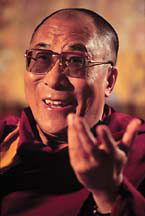 Dalai Lama |
| to an act of violence by
employing the principles of non-violence. This is of great importance.
The attacks on the United States were shocking, but retaliation that
involves the use of further violence may not be the best solution
in the long run. We must continue to develop a wider perspective, to think rationally and work to avert future disasters in a non-violent way. These issues concern the whole of humanity, not just one country. We should explore the use of non-violence as a long-term measure to control terrorism of every kind. We need a well-thought-out, coordinated long-term strategy. I believe there will always be conflicts and clash of ideas as long as human beings exist. This is natural. Therefore, we need an active method or approach to overcome such contradictions. In today's reality the only way of resolving differences is through dialogue and compromise, through human understanding and humility. We need to appreciate that genuine peace comes about through mutual understanding, respect and trust. Problems within human society should be solved in a humanitarian way, for which non-violence provides the proper approach. Terrorism cannot be overcome by the use of force because it does not address the complex underlying problems. In fact the use of force may not only fail to solve the problems, it may exacerbate them and frequently leaves destruction and suffering in its wake. Likewise, acts of terrorism, especially involving violence, only make matters worse. We must condemn terrorism not only because it involves violence but also because innocent people fall victims to senseless acts of terrorism such as what the world witnessed on September 11th. Human conflicts do not arise out of the blue. They occur as a result of causes and conditions, many of which are within the protagonists' control. This is where leadership is important. It is the responsibility of leaders to decide when to act and when to practise restraint. In the case of a conflict it is important to take necessary preventive measures before the situation gets out of hand. Once the causes and conditions that lead to violent clashes have fully ripened and erupted, it is very difficult to control them and restore peace. Violence undoubtedly breeds more violence. If we instinctively retaliate when violence is done to us, what can we expect other than that our opponent to also feel justified retaliating. This is how violence escalates. Preventive measures and restraint must be observed at an earlier stage. Clearly leaders need to be alert, far-sighted and decisive. In today's world expectations of war have changed. It is no longer realistic to expect that our enemy will be completely destroyed, or that victory will be total for us. Or for that matter, can an enemy be considered absolute. We have seen many times that today's enemies are often tomorrow's allies, a clear indication that things are relative and very inter-related and inter-dependent. Our survival, our success, our progress, are very much related to others' well being. Therefore, we as well as our enemies are still very much interdependent. Whether we regard them as economic, ideological or political enemies makes no difference to this. Their destruction has a destructive effect upon us. Thus, the very concept of war, which is not only a painful experience, but also contains the seeds of self-destruction, is no longer relevant. Similarly, as the global economy evolves, every nation becomes to a greater or lesser extent dependent on every other nation. The modern economy, like the environment, knows no boundaries. Even those countries openly hostile to one another must cooperate in their use of the world's resources. Often, for example, they will be dependent on the same rivers or other natural resources. And the more interdependent our economic relationships, the more interdependent must our political relationships become. What we need today is education among individuals and nations, from small children up to political leaders to inculcate the idea that violence is counterproductive, that it is not a realistic way to solve problems, and that dialogue and understanding are the only realistic way to resolve our difficulties. The anniversary of the tragic events of September 11th 2001 provides us with a very good opportunity. There is a worldwide will to oppose terrorism. We can use this consensus to implement long-term preventive measures. This will ultimately be much more effective than taking dramatic and violent steps based on anger and other destructive emotions. The temptation to respond with violence is understandable but a more cautious approach will be more fruitful. See also: Achieving World Peace in the Modern World : Extract from the Dalai Lama’s Speech Given to the European Parliament, 24 October 2001 Source: Tibetan Govenment in Exile |
|
©
One World One People, 24 October 2002
This Web page may be linked to any other Web sites. Contents may not be altered
This Web page may be linked to any other Web sites. Contents may not be altered