|
My time in Romania is almost over. This train is taking me to Sinaia,
site of the country's most spectacular castle, and a mountain that
peaks at two thousand metres. I'm told it's quite chilly at the
top, so I'm wearing long trousers. After that, it's a whistle-stop
tour of other towns I want to see, before some long bus rides in
the general direction of London (what, fly? who, me?)
A number of people have asked me why I came here. The best of a
number of possible answers is this: adventure. I wanted to experience
a new country and culture in a more in-depth way than my backpacking
scuttles through South-East Asia and Western Europe provided. Volunteering
for a humanitarian organisation gave me the chance to do this, and
something worthwhile as well. In many ways, I found just what I
would have expected; a mission that has accomplished nothing short
of a miracle in a place of desperate need, and a group of special
kids and young adults who opened their hearts and captured mine.
But what has impacted me the most has been the host of remarkable
people I've met in this country. Men and women who've responded
to great need with great acts of commitment and sacrifice. If you
have a few minutes, I'd like to introduce a few of them.
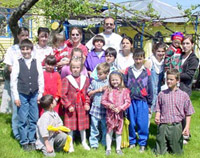
Take Bruce and Sandy Tanner, an American couple who some twelve
years ago saw a television program called "Shame of a Nation"
that deeply impacted them, and galvanised them to action (how often
have I seen similar media images, and felt the emotions without
being prompted to action?) They sold up shop, moved to Nicoresti,
a small Romanian village, and spent the initial years simply serving
in the local spital (a hospital for people with mental and physical
disabilities). Gradually, after struggling through much administrative
red tape, they managed to get some children out of that dreadful
environment and into a home. Now, more than a decade later, they
oversee five group homes full of thirty-three beautiful kids who
are thriving. Tanner Romania Mission continues to contribute to
the village, and the spital. They're a huge presence in the village
- everyone knows Mama Sandy and Tata Bruce. Sandy once pointed to
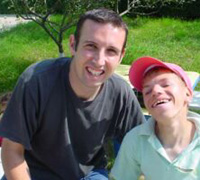
Florentine, a delightful chap with severe cerebral palsy, who recently
celebrated his nineteenth birthday, and told me, "If it was
just him, if he was the only one, it would be worth it." She
means that.
Then there's Pauline Walsh. A bona fide modern saint, this Irish
lass has been serving at the Nicoresti spital for more than four
years. I never fully appreciated what this meant, until I visited
there in my final week. Home to some eighty adults with various
mental and physical disabilities, it's a truly desperate place (the
younger children are all, thank God, now all under TRM roofs, or
in relatively humane conditions in nearby Galati). Many of the residents
wander zombie-like around cold dark corridors, others cringe under
dirty bed sheets for weeks, months on end. I saw two men chained
to their beds. I saw an ill man sitting in his own defecation, days-old
dressings unchanged, as paid local staff sat drinking coffee. Physical
and sexual abuse is commonplace. Wild dogs roam the corridors and
the eating hall, and the place stinks. I learnt early on not to
ask Pauline how her day was - in a place like that, it's only varying
degrees of awful. In the face of it all, Pauline has maintained
a wicked sense of humour, a wry smile and a very distinctive laugh.
Perhaps that's her greatest achievement.
If you've never met Conor Hughes, you've missed out. Conor embodies
everything that's great about the Irish - big-heartedness, self-depreciation,
and a formidable sense of humour. A long-term fundraiser and rallier
of support for TRM he is, along with its founders, the heart and
soul of the mission. He's a businessman and musician, yet despite
his many commitments, makes the trip out to Nicoresti like it's
an outing to the shops (he was here twice during the last three
months, and will be out again in January). I once asked Conor why
he does it. He shrugged and said, "The adventure, I suppose",
a reply that struck a chord with me. Conor equally loves the children
at the group homes, and the remaining adult residents of the spital.
It makes me smile to think about the man who's crossed paths with
the likes of U2, taking walks with the crooked, withered residents
of a mental hospital in a tiny Romanian village. Ask most people
in the world to name a famous Irish musician with scraggly black
hair, and they'll name Bono. Ask the same of the residents of TRM
homes, or the Nicoresti spital, and they'll tell you about the man
who often turns up, armed with a mandolin, a ready smile, and a
silly dance.
These people are a very diverse group - at face value, they have
little in common. In fact, most of their similarities are in things
they don't do. None count the cost. None, as far as I know, have
sweeping visions of bringing change to entire nations or communities.
None have political aspirations to effect change through social
policy (such people are surely needed, but they are not them). Rather,
they are satisfied to make a difference to the lives of a small
handful of people who otherwise have no one to advocate for them.
They seek no credit or recognition for what they do, indeed, they
refuse to see what they are doing as particularly special or unusual.
Where I would be daunted by the magnitude of the problem, and struggle
to see how I could make any difference, they refuse to think in
terms of numbers or statistics - to them, just one baby, child or
adult is worth moving mountains for.
If you've ever given thought to doing voluntary humanitarian work,
I can only offer my heartiest encouragement. Volunteers enable many
organisations to go beyond providing basic human needs like food
and shelter, to sharing life, colour and joy. You have a combination
of skills and personality traits that no one else can offer. Go
on, look into it. After all, you only have one life to live.
|