|
Ever wondered where the tasty sugar of your can of Coca Cola comes
from? Odds are it is from an El Salvadorian sugarcane mill, which
openly uses child labor. Children as young as eight work for up
to eight hours a day in hot sun, cutting sugar cane with huge machetes.
It is dangerous work, and injuries, sometimes life threatening,
are all too common. Other children labor in sweatshops making garments
for western countries, children climb landfills in order to collect
recycling to sell, and young girls risk physical and sexual abuse
by working in the domestic sector.
Perhaps the most visible of child labor in El Salvador, is children
working in the marketplace. The kids can be seen selling goods and
services in the streets, and in local markets, some as young as
four and five. This work often includes running in and out of traffic,
backbreaking work carrying goods, and working in the extreme heat.
Education is expensive, and many poverty-stricken families cannot
afford to send their children to school. Children instead spend
hours working, their childhood stripped from them, in order to survive.
By volunteering through the Global Volunteer Network, Lauren McElroy
of Washington, U.S was able to visit El Salvador to see first hand
how these people live, and to work for a program that helps to give
the children a break from that environment.
'One of my friends had gone to El Salvador the year before, and
she said what an amazing experience she'd had, and that she was
going back again' says Lauren, reflecting on her 5 weeks spent volunteering.
'I was just getting back into Spanish, so I was able to go. I knew
that I could actually be able to talk to the kids, and I felt like
that would make more of a difference.'
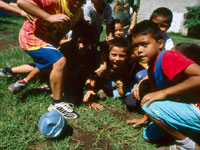
Lauren volunteered with a program called 'Angeles Descalzos' which
means 'fallen angels'. The program is for kids who work in the marketplace,
many whom are unable to afford to go to school, and provides them
with the chance to learn and play.
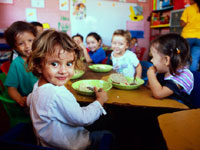
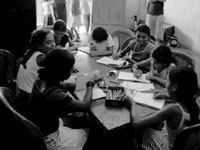
'We had a morning and an afternoon session. I taught some English,
because a lot of the kids didn't go to school, and English is something
that really they can only learn in school. It's really useful, for
them, because there's a lot more opportunities if you know English,
both educational, and job opportunities.'
The children come to the program part time, when they are not working,
and are able to come to this program free of charge, thanks to the
support of volunteers.
The program enables the marketplace children to take some time out,
and provides an environment where they can be themselves and enjoy
their youth, as many of the children that Lauren met had been working
as long as they could remember.
'My friend Lisa who came with me is a Theatre Major, so we did Drama,
which is really fun, just to try to get the kids to be a bit more
creative and have fun. They don't have board games and store-bought
toys like in developed countries. They are not really encouraged
to be creative, and to just play.'
| The Civil War in
El Salvador which raged for over a decade, ended in 1992 and
left around 70,000 people dead, causing over two billion dollars
in damages. This put a huge strain on the already struggling
economy, and left thousands of men, women and children alike
maimed, injured and emotionally scarred. Although the war officially
ended in 1992, it still has a massive impact on the day to day
life of El Salvador's people. Many are still left suffering,
coming to terms with war related injuries and illness. |
 © Courtesy:
Global Volunteer Network
© Courtesy:
Global Volunteer Network
|
Lauren stayed with a host family, and was able
to see first hand the impact of the war on everyday families in
El Salvador.
'Their dad had been in the war, and he had been injured, and had
just started to work again in a sweatshop in San Salvador, which
is about a three hour bus ride from Santa Ana where he lived. He
would go there every week, and he would have basically day long
shifts, up to 24 hours, so he would stay there overnight and come
back on weekends. It was amazing to see the sacrifice that he made
for his family, and hear about his experiences fighting in the war
and being injured, then recovering, and trying to get back into
the workforce.'
Staying with a host family also provides them with a valuable extra
income. Lauren's host family could then afford to send two of their
children to school. One has also recently been able to attend University,
thanks to the extra income provided by hosting volunteers.
'They had four daughters, two of whom were disabled. Basically they
couldn't stand up, and they couldn't talk. They were bedridden because
they had been born with these birth defects'. 'Just to see the mom,
Leila, taking care of these girls, who were twelve and fourteen
when I was there. They were grown girls, but she had to stay in
the house with them all the time. To see her dedication to them,
and the way the whole family just embraced them, and treated them.
The whole story of the host family was amazing. They were so inspirational,
just incredible.'
Volunteering in El Salvador also brought Lauren the obvious challenges,
such as the language barriers, but these were quickly overcome.
Other challenges were not so obvious. Learning about kids lives
which are so different from our own childhoods can be heartbreaking.
'When the kids are telling you their stories, you just want to be
able to change everything. I was only there for five weeks, and
you can't change everything. Just knowing that you were going to
leave, and they are going to stay there and still be having the
same life, I think that was really hard, and one of the biggest
challenges. To do what you can, and accept the fact that things
aren't going to change overnight. You have to just let that be,
and do what you can while you are there.'
The program, which receives very little government funding, relies
on volunteers, mainly from foreign countries, to teach the classes
and maintain the program. If it wasn't for volunteers like Lauren,
programs like 'Angeles Descalzos' would not be able to stay running.
'Just the fact that they were able to come to this program, not
be out in the market working, have some education, have some fun,
some time to play, and have a glimpse into an outside world. They
asked us 'oh, what's it like in the United States', and about our
lives. A lot of these kids have never even left Santa Ana, the city
we were in, so even that I think was really valuable for them.'
By volunteering, Lauren was able to really develop friendships with
these children, which is a totally unique element of traveling in
a third world country.
'One weekend we went to the market that a lot of these kids worked
at, and we saw one of the girls with the basket on her head of the
fruit, one of the girls from the project that we knew. We kind of
waved at her and said hi, as she was just walking by.'
'When you picture a country like that when you go there, you see
these kids out there selling things, but you don't really have a
personal relationship with them, so it just gave an incredibly different
face and a different perspective on child poverty and child labor.
It was really different when you knew the kid, and knew about their
daily life, and had a relationship with them, rather than when it
was just some faceless kid trying to sell you something. I have
much more compassion, and respect, and understanding of their lives,
and what that's like.'
GVN has several programs in El Salvador, including teaching English
to children from the marketplace, or children who collect rubbish
at landfills for recycling. There are also community maintenance
programs, and the opportunity to work in an orphanage desperate
for help.
If you are interested in volunteering in El Salvador, visit www.volunteer.org.nz
|